
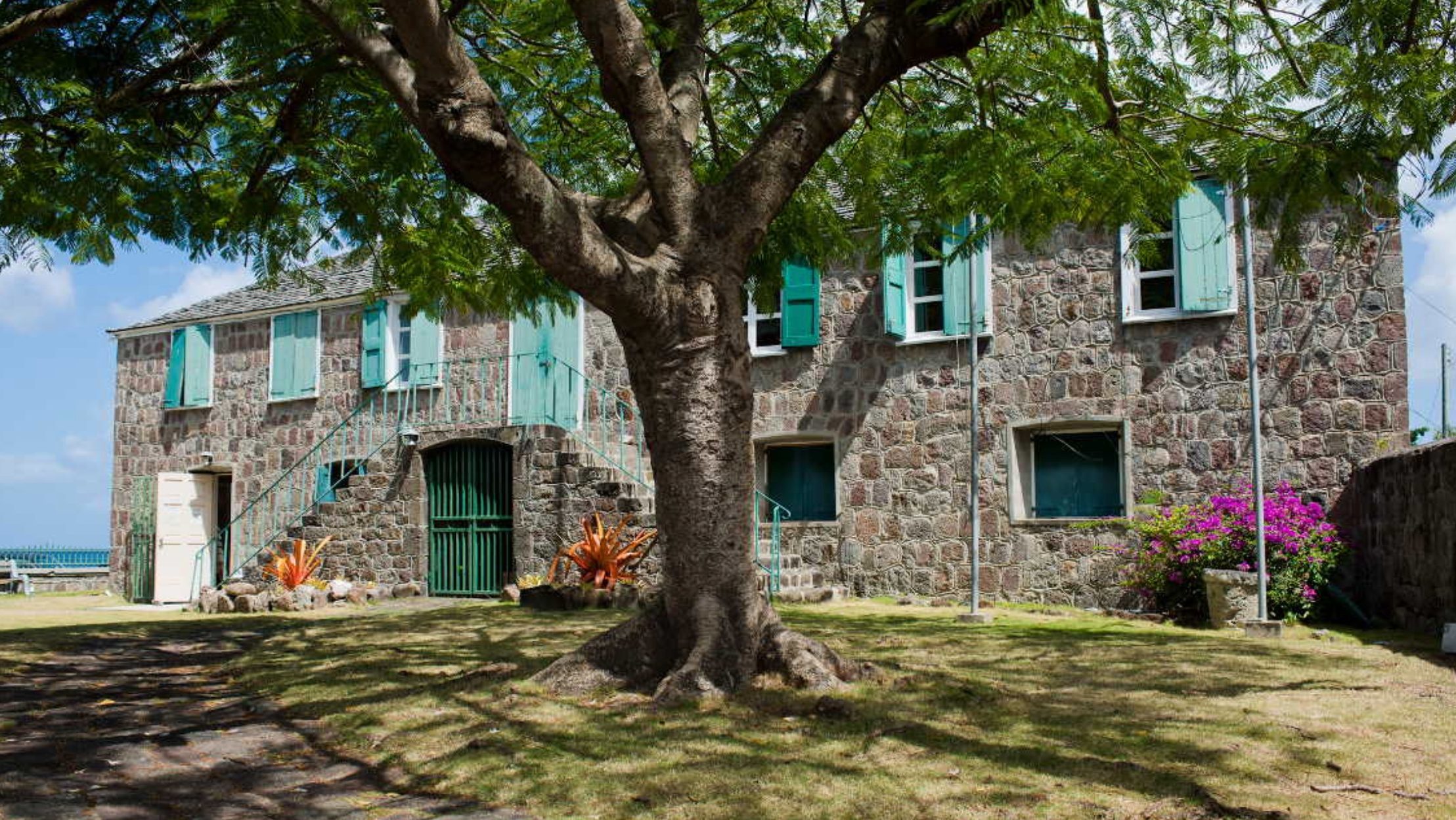
This two-story Georgian style building, in Charlestown, Nevis Island, US Virgin Islands was the birthplace of Alexander Hamilton. (Photo courtesy of NevisIsland.com)
[Updated January 11, 2026]
I originally wrote this post under the title “Small World.” In light of this year’s 250th Anniversary of our Declaration of Independence, I’ve revised it to align with the intent of making this Anniversary resonate locally. This is the first of several posts I will either update or write in honor of our Big Birthday.
While researching the American Revolutionary period in Beaufort, I found a detail about Peter Lavien (1746-1781), a prominent merchant who moved there from Sankt Croix in 1765. Despite his thriving business, the revolution disrupted his life, and he became a Tory loyalist to Britain. After more than ten years in Beaufort, he moved to Savannah, GA. Interestingly, his younger half-brother also moved to the Colonies from Sankt Croix a few years later, in 1772.
Peter’s half-brother was Alexander Hamilton, born on January 11, 1755 (or possibly 1757; historians differ on the year). Yes, The Alexander Hamilton.
A Rough Childhood
Peter was born in 1746 to John Lavien (1717 – 1771) and his wife, Rachel Faucette (1729 – 1768). They had been married the year before. It seems John married Rachel for her money. Her father died in 1744, leaving her with “a snug fortune.” John was not wealthy, but he sought permission from her recently widowed mother, Mary Uppington Faucette, for her hand. Soon after Peter’s birth, life became unbearable for Rachel. In 1750, she refused to live with John anymore and took up residence with a single man. She was accused by her husband of infidelity, convicted (twice), and jailed! [Newton] We know, as best we can, that she was indeed adulterous because of extensive court records that have survived. We don’t know, and probably never will, whether she was driven away from her husband by his actions.
Rachel was released from prison after eight months and fled to Nevis Island in the British West Indies. There, she met and fell in love with James A. Hamilton. They had two sons, James Jr. Hamilton (1753 – 1786) and Alexander Hamilton (1755 – 1804). Unfortunately, the sons were born out of wedlock, a fact that would complicate their lives for years. When John Lavien eventually divorced Rachel in 1759, Danish law did not allow her to remarry.
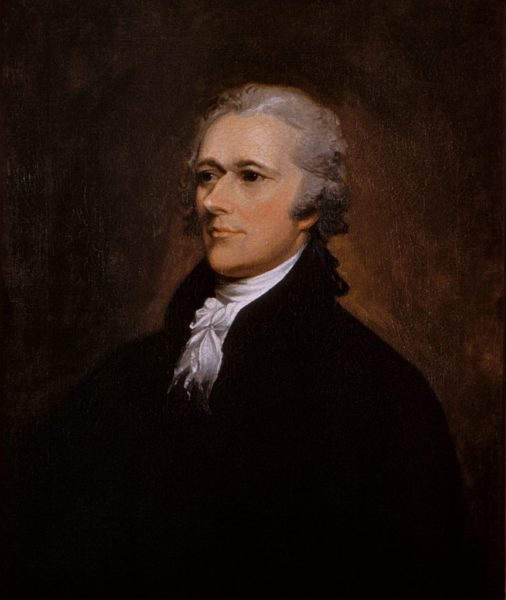
The illegitimate son above is THAT Alexander Hamilton, military aide to General Washington, author of most of the Federalist Papers, first Secretary of the Treasury, and the subject of Hamilton: An American Musical.
It is a small world. We now live a short distance from where Alexander Hamilton’s half-brother once lived. Unfortunately, there is no indication that Alexander ever visited Beaufort or even South Carolina. But there is every indication he had a huge impact on our nascent nation.
Brother – Peter Lavien (1746 – 1781) – the Tory
As mentioned earlier, Peter Lavien moved to Beaufort in 1765 at age 18. According to several sources, he became quite wealthy as a shipping merchant. When his mother, Rachel, died in 1768, he was the only legitimate heir among her three sons. Peter returned to Sankt Croix in 1769 to take possession of his inheritance from his mother’s estate. Early in the American Revolution, Peter was Beaufort’s most prominent Tory smuggler [Rowland, Volume 1, pg. 244]. As the war progressed, he moved to Savannah in 1777 and lived with his daughter, Joanna, and son-in-law, John C. Lucena. Peter Lavien died in Savannah in 1781; his burial location is unknown. His property in Beaufort was disposed of by his former partner’s stepson, John Kean. Kean was a patriot and eventually became a nationally prominent politician in the late 18th century [Rowland, Volume 1, Pages 244-245].
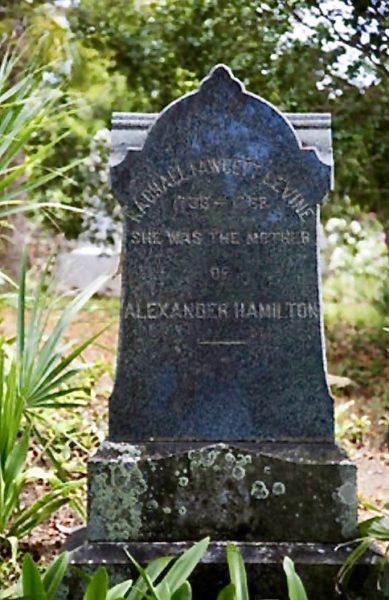
Mother & Father – Rachel Faucette Lavien (1729 – 1768) & James A. Hamilton (1718 – 1799)
Rachel’s life with James Hamilton was generally normal for the next 15 years. They raised their two sons in Christiansted, Sankt Croix, as husband and wife, and she died in 1768. A friend of Rachel’s bought her family’s books and returned them to Alexander. It’s unclear whether their father had the means or ability to formally adopt his sons, James Jr. Hamilton and Alexander Hamilton. The Hamilton brothers were soon separated.
Thomas Stevens, an import-export merchant, primarily raised Alexander. Through the generosity of community leaders, he was sent to North America for his education, arriving in October 1772 at age 17. The 34 books Alexander received from his mother’s estate were instrumental in his education. Within two years, he had graduated from King’s College, now Columbia College, within Columbia University.
By 1771, John Lavien (Rachel’s “first” husband) and his second family had all passed away on Sankt Croix.
The Patriot – Alexander Hamilton (1755 – 1804)
I’ve listed a few of the many great books about Alexander Hamilton in the sources below. To have risen from this kind of childhood, in a place of sugar plantations and poverty, to a Founding Father of the United States is remarkable. He kept in touch with his biological father after his mother’s death and was aware of his half-brother’s life in South Carolina and then in Georgia. When Alexander Hamilton heard of Peter’s death, he wrote to his wife, Elizabeth Schuyler Hamilton,
“Engrossed by our own immediate concerns, I omitted to tell you of a disagreeable piece of intelligence I have received from a gentleman of Georgia. He tells me of the death of my brother Levine [sic]. You know the circumstances that abate my distress, yet my heart acknowledges the rights of a brother. He dies rich but has disposed of the bulk of his fortune to strangers. I am told he has left me a legacy. I did not inquire how much.”
Alexander Hamilton and his wife, Elizabeth Schuyler (1757 – 1854), had eight children. All lived to adulthood, though his oldest son, Philip, died in a duel at the age of 19. The story of Alexander’s death is a longer tale. The short version is that he was killed in a duel with Aaron Burr in 1804. His wife spent the next 50 years preserving her husband’s legacy. Both are buried in Trinity Churchyard in Manhattan, NY.
Given the circumstances surrounding his mother’s early marriage and indiscretions, I wondered what Alexander Hamilton thought of her. In 1834, John C. Hamilton published a biography of his father. In it, he wrote this about his father Alexander’s view of his own mother Rachel,
“…the traces of her character remained vividly impressed upon his memory. He recollected her with inexpressible fondness and often spoke of her as a woman of superior intellect, highly cultivated, of elevated and generous sentiments, and of unusual elegance of person and manner.”
Epilogue
There is no direct Sams connection this week, just a “small world” trace to Beaufort. But maybe Alexander Hamilton was the talk of Wadmalaw Island, even among William Sams and his neighbors, when our nation was in the heat of our American Revolution.
Recently, Peter Lavien’s will was discovered at the Liberty Hall Museum at Kean University in Union, NJ. We now know that the ‘legacy’ left to each of his brothers (Alexander and James Hamilton) was one hundred fifty pounds sterling, equivalent to $36,000 today.
For your awareness, the surname Lavien is sometimes spelled Lavein or Lavine. The name Rachel Faucette is sometimes spelled Rachael Fawcett.
Sources
Recommended reading
Chernow, Ron (2005). Alexander Hamilton. Penguin Press. ISBN 978-0-14-303475-9. [This book was the inspiration for Hamilton: An American Musical]
Hamilton, Allan McLane (1910). The Intimate Life of Alexander Hamilton. Reprinted in 2016. [Written by his grandson using some original family records.]
Hamilton, John C. (1834). The Life of Alexander Hamilton
Newton, Michael E. (2019). Discovering Hamilton: New Discoveries in the Lives of Alexander Hamilton, His Family, Friends, and Colleagues, From Various Archives Around the World
References
Rowland, Lawrence S., Moore, Alexander, Rogers Jr., George C. – The History of Beaufort County, South Carolina, Volume I, 1514 – 1861, 1996.
Wikipedia, topics = Alexander Hamilton, Elizabeth Schuyler Hamilton, John Lavien, 10 Aug 2020.
#52Sams Week 32 – Small World